
Across most of the developing world, the story of the last two decades has been a hopeful one: as people come online, the digital economy grows, services expand, new businesses take root, people make more money and lift themselves by their bootstraps. Tanzania was supposed to follow that script, but it hasn’t.
A new report from IGP, sponsored by the Tech and Media Convergency (TMC), investigates an unfortunate divergence in Tanzania’s development. While internet adoption has climbed to roughly one-third of the population, the expected digital economic growth has failed to materialize. The research argues that the bottleneck is not a lack of infrastructure, but a self-reinforcing system of restrictive governance.
The Tanzanian Anomaly
As internet use rose from negligible levels in the early 2000s to approximately 31% today, Tanzania’s services sector contribution to GDP has actually contracted, falling from a 2001 peak of 49% to 29% in 2024 (black-dotted and red lines below).
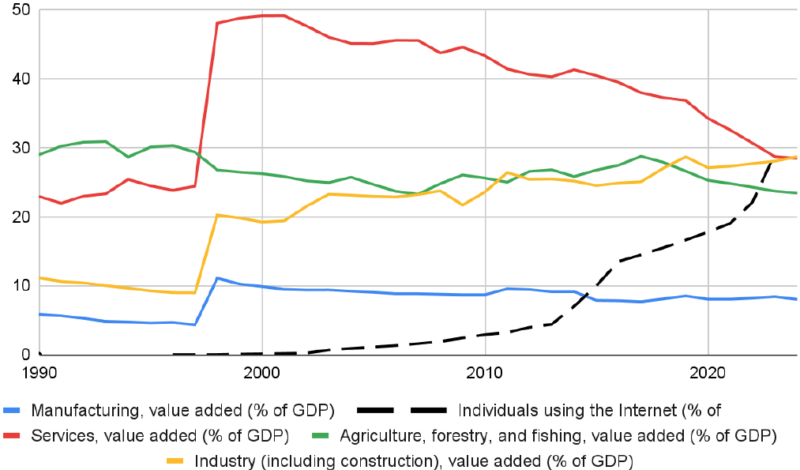
The ICT sector itself has stagnated at 1.5% to 1.6% of GDP. Comparing Tanzania to Kenya, a neighbor with similar demographics and nearly identical internet penetration (~35%), reveals the scale of the under performance. Kenya’s services sector accounts for roughly 55% of its economy, nearly double Tanzania’s. In the broader digital economy, including fintech and platform commerce, Tanzania’s contribution is less than one-fifth that of Kenya’s.
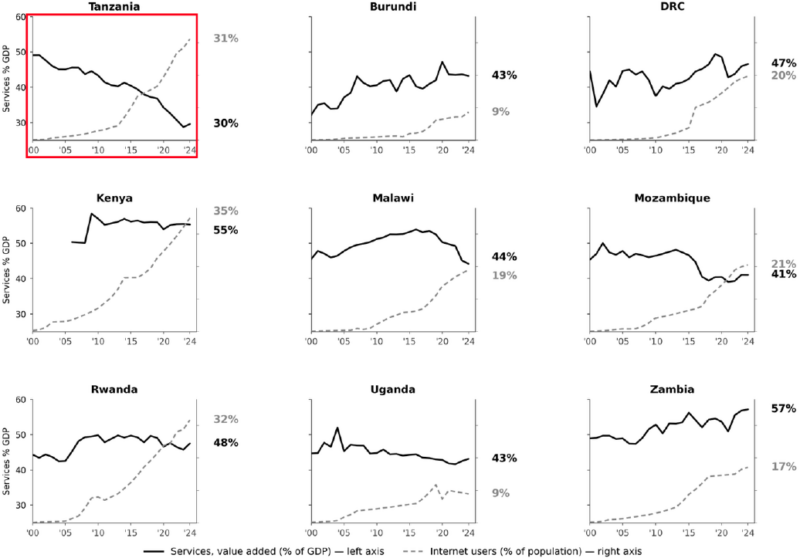
In fact, the pattern runs similar for every one of Tanzania’s neighbors (figure below) where rising connectivity tracks with a growing or stable services sector. A positive relationship between internet adoption and services value-added appears everywhere except Tanzania, which moves in the opposite direction.
Wrong turns in digital governance
The study identifies three interlocking policy failures that, together, suppress the productive use of Tanzania’s growing connectivity.
Digital sovereignty: Mandates for data localization and local ownership force costly, redundant infrastructure and deter foreign investment without delivering any of the privacy or security benefits used to justify them.
Censorship, Surveillance, and Restrictions: A restrictive framework of content licensing, VPN registration, and internet shutdowns creates direct economic damage, including an estimated US$250 million in losses during the 2025 election period alone.
Cronyism: the most insidious factor aligning regulatory authority with private commercial interest. Here we find that sovereignty and censorship mandates are not independent policy choices but downstream instruments of a patronage system in which the ruling party, telecom operators, and regulators are bound together by shared interest using regulatory power to protect insiders from competition.
A maladaptive system
What makes the report distinctive is its insistence that these are not errors to be corrected with better technical advice. They form a self-reinforcing equilibrium that restricts growth. Restrictive policies create discretionary regulatory power; that power creates opportunities for extraction; and extraction creates vested interests in keeping the restrictions in place. Drawing on the political-economy framework of North, Wallis, and Weingast, we describe a “limited access order” a system in which a ruling coalition distributes economic privileges to insiders precisely to prevent outsiders from competing while using ICTs to stifle elections and free expression.
This is why we argue that incremental reforms under President Samia Suluhu Hassan have not changed the sector’s trajectory. The underlying incentive structure between regulator and regulated remains intact. The report also explains the widening gap between Tanzania’s ambitious strategic documents like its Vision 2050, the Digital Economy Strategic Framework 2024–2034, and the regulatory machinery that quietly continues to operate against them. The aspirational language of digital transformation has not replaced the architecture that suppresses it. The two simply coexist in a performative theater of legitimacy.
A way out that the state can live with
The report closes with ten concrete policy recommendations, but its framing is unusual for work in this space. Rather than calling for the ruling party to abandon the governance logic that sustains its dominance, (a clear political non-starter) we propose reforms calibrated to be politically survivable: revoking data localization mandates, introducing risk-based cross-border data rules, establishing judicial oversight for data access, liberalizing content licensing, opening up wholesale infrastructure, and replacing ownership caps with competition-based assessments.
Each recommendation can be justified on fiscal grounds alone. A larger, more dynamic ICT sector would broaden the tax base, attract foreign investment, and create jobs thereby offsetting the perceived loss of control with gains that accrue to all stakeholders, including the state. A more abundant and independent digital economy would even lower the stakes of political competition, making any future transfer of power less destabilizing.
Whether any of it happens depends on a race we can identify but not resolve, that is, whether the mounting economic costs of the current system will force change before an expanding surveillance apparatus from mandatory SIM registration and the forthcoming Jamii Namba digital ID, locks in a more durable architecture of control. For now, Tanzanians keep coming online. The question is whether being online will ever be allowed to pay off.
“The Political Economy of Digital Governance in Tanzania: Pathways to ICT Sector Growth” is an Internet Governance Project report sponsored by the Tech & Media Convergency. Read the full report here.
The post Tanzania Is Getting Online. Its Digital Economy Isn’t Following. appeared first on Internet Governance Project.
