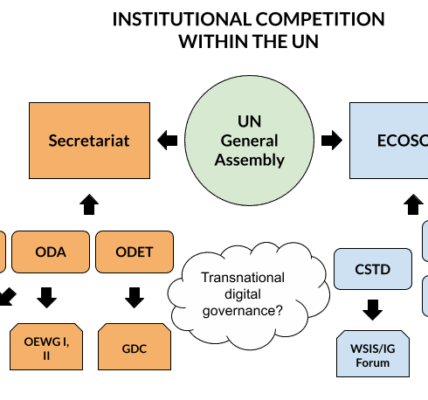
What should become of the World Summit on the Information Society? The WSIS+20 review process, culminating at the UN General Assembly in December 2025, will assess progress made since the original WSIS and chart a course for its future. The UN is preparing a “Zero draft” and asked for comments from the public. This is what IGP told them.
1. What are the most important achievements arising from WSIS that should be highlighted in the Zero Draft?
The most significant and enduring achievement of WSIS is the establishment of the Internet Governance Forum (IGF). As a cornerstone of the WSIS vision, the IGF has played a pivotal role in advancing multistakeholder cooperation on critical technology and policy issues central to the Information Society. By operationalizing the principles outlined in the Geneva Declaration and Tunis Agenda, the IGF has fostered inclusive, global dialogue for over two decades.
Its success is evident in the sustained participation of diverse stakeholders worldwide and the proliferation of national and regional IGFs—now exceeding 175 initiatives—demonstrating its far-reaching impact. Contrary to the characterization in the Elements paper as merely an annual event, the IGF sustains a dynamic, year-round ecosystem of collaboration through intersessional programs (such as Dynamic Coalitions, Best Practice Forums, and Policy Networks) and a robust network of local, youth, and regional Internet governance efforts.
This model of multistakeholder governance, pioneered by the IGF, remains one of WSIS’s most transformative outcomes and should be prominently recognized in the Zero Draft.
2. What are the most important challenges to the achievement of WSIS outcomes to date and in the future that need to be addressed in the Zero Draft?
We see the absence of a permanent mandate for IGF as a critical challenge that should be addressed in the zero draft. We also view the disconnect between the WSIS Forum and the discussions that happen at IGF as another challenge.
3. What are the most important priorities for action to achieve the WSIS vision of a ‘people-centred, inclusive and development-oriented Information Society’ in the future, taking into account emerging trends?
Internet Governance
The IGF remains vital but must evolve to reflect its broader role in digital governance, not just Internet governance. Its structure should shift toward a true multistakeholder partnership, reducing unilateral UN control and fostering equitable collaboration among governments, civil society, the private sector, and technical communities.
The WSIS process should move beyond “enhanced cooperation”—a term that, in 2005, served as diplomatic cover for intergovernmental disputes over DNS root oversight. The 2016 IANA transition resolved that debate by ending U.S. control, making the term obsolete. Instead, prioritization should be given to:
- Creating stronger integration with National and Regional IGFs (NRIGFs)
- Ensuring IGF programming integrates bottom-up proposals from NRIGFs and other members of the public.
Human Rights and the Information Society
The Elements paper’s approach to human rights is deeply flawed, prioritizing state control over individual empowerment. While it correctly affirms that offline rights must apply online—including freedoms of expression and assembly—its operational language undermines these principles.
Problematic elements include:
- Vague calls for “actions against abusive uses of ICTs”, which risk legitimizing censorship.
- Overemphasis on permissible restrictions (e.g., for “national security” or “public morals”), framing rights as conditional rather than fundamental.
- Conflating ethics with repression, enabling governments to weaponize “integrity” narratives to justify surveillance and suppression.
This approach contradicts WSIS’s people-centered vision. Human rights frameworks exist to constrain state power, not to justify its expansion. The WSIS+20 review must reject this regressive rhetoric and instead:
- Unambiguously center freedom of expression as non-negotiable.
- Address digital rights threats (e.g., censorship, mass surveillance) without legitimizing them under the guise of “ethics.”
4, What additional themes/issues, if any, should be included in the Elements Paper?
The Digital Economy deserves greater emphasis in the WSIS+20 review, as it serves as the foundation for many critical issues currently addressed in isolation. A thriving global digital economy depends on the cooperative, multistakeholder frameworks that the UN and IGF are uniquely positioned to advance. Key sub-themes—such as ICT for development, social and cultural progress, bridging digital divides, data governance, and financial inclusion—are intrinsically linked to the growth of a digital economy built on Internet-based infrastructure. For example:
- Private sector investments in connectivity (e.g., broadband expansion, cloud services) have driven accessibility.
- E-commerce, digital banking, and cryptocurrencies have revolutionized payment systems.
- Cross-border flows of capital and knowledge have accelerated innovation, including in AI and other transformative technologies.
However, the rise of digital sovereignty policies threatens this progress by imposing fragmented, territorial restrictions on data, services, hardware (e.g., semiconductors), and digital trade. Such measures risk stifling the very cooperation needed to sustain inclusive growth. The Elements Paper should:
- Explicitly recognize the digital economy as a cross-cutting priority, central to achieving WSIS goals.
- Reject digital sovereignty frameworks that undermine global interoperability and economic development.
By anchoring these issues in the broader digital economy narrative, the WSIS+20 review can better align its objectives with today’s technological and economic realities.
5. Do you wish to comment on particular themes/issues/paragraphs in the Elements Paper?
The WSIS+20 review represents a critical opportunity to ensure coherence between WSIS implementation and the Global Digital Compact (GDC).
We emphasize three key points:
- Avoid Parallel Processes: The GDC must not develop as a competing or duplicative multilateral framework, but rather as a complementary initiative reinforcing WSIS principles. The GDC’s 70 commitments span critical areas: from closing digital divides, promoting and protecting human rights, connecting schools and hospitals, to facilitating data flows with trust, and misinformation and disinformation, intersecting with the WSIS Action Lines at many points.
- Institutional Alignment: Should the UN Office for Development and Technology (UN ODET) assume GDC implementation responsibilities, its mandate must explicitly support and enhance existing WSIS mechanisms, particularly the Internet Governance Forum (IGF).
- Operational Synergy: All GDC implementation activities should be designed to strengthen rather than duplicate WSIS implementation structures, maintaining the IGF’s central role in multistakeholder digital governance.
This approach will prevent fragmentation of global digital governance efforts while preserving two decades of institutional knowledge and stakeholder engagement developed through the WSIS process.
6. What suggestions do you have to support the development of the WSIS framework?
To strengthen the WSIS framework, we propose that the UN Office for Digital and Emerging Technology (UN ODET) establish structured multistakeholder dialogues to develop consensus on digital governance norms, focusing on policy issues that have matured within IGF discussions. However, any such mechanism must address the historical exclusion of non-state actors in UN-led processes. Critical reforms should include implementing robust metrics to evaluate WSIS Action Line outcomes and ensure greater accountability. For the IGF specifically, we recommend rebalancing the MAG’s composition to ensure equitable stakeholder representation while allowing communities to directly appoint their representatives. The Leadership Panel should be eliminated to reduce hierarchies, and parliamentary participants should be better integrated into core programming. Financially, the IGF should diversify its funding sources with a target of securing 50% from non-UN entities within three years. Finally, oversight of the IGF’s mandate should shift from the UN General Assembly to the IGF itself, with the CSTD retaining an advisory role to maintain member state input while reducing bureaucratic burdens. These changes would modernize the WSIS framework while preserving its multistakeholder foundation.
The post WSIS+20 Stakeholder Consultations: IGP’s Input appeared first on Internet Governance Project.